6 RSA Signatures
\[ \newcommand{\F}{\mathbb{F}} \newcommand{\G}{\mathbb{G}} \newcommand{\N}{\mathbb{N}} \newcommand{\R}{\mathbb{R}} \newcommand{\Z}{\mathbb{Z}} \newcommand{\Zq}{\Z_q} \newcommand{\zo}{\{0,1\}} \newcommand{\bin}{\zo} \newcommand{\zon}{\{0,1\}^n} \newcommand{\A}{\mathcal{A}} \newcommand{\B}{\mathcal{B}} \newcommand{\calA}{\mathcal{A}} \newcommand{\calB}{\mathcal{B}} \newcommand{\calC}{\mathcal{C}} \newcommand{\calD}{\mathcal{D}} \newcommand{\calK}{\mathcal{K}} \newcommand{\calM}{\mathcal{M}} \newcommand{\calT}{\mathcal{T}} \newcommand{\calX}{\mathcal{X}} \newcommand{\calY}{\mathcal{Y}} \newcommand{\xor}{\oplus} \newcommand{\cross}{\times} \newcommand{\deq}{\mathrel{\mathop:}=} \newcommand{\abs}[1]{\left| #1 \right|} \newcommand{\set}[1]{\left\{ #1 \right\}} \renewcommand{\vec}[1]{\mathbf{#1}} \newcommand{\poly}{\operatorname{poly}} \newcommand{\negl}{\operatorname{negl}} \newcommand{\classP}{\mathsf{P}} \newcommand{\classNP}{\mathsf{NP}} \newcommand{\INDCPA}{\text{IND-CPA}} \newcommand{\Enc}{\mathsf{Enc}} \newcommand{\Dec}{\mathsf{Dec}} \newcommand{\Gen}{\mathsf{Gen}} \newcommand{\Derive}{\mathsf{Derive}} \newcommand{\Sign}{\mathsf{Sign}} \newcommand{\Ver}{\mathsf{Ver}} \newcommand{\MAC}{\mathsf{MAC}} \newcommand{\MACSign}{\mathsf{MAC.Sign}} \newcommand{\MACVerify}{\mathsf{MAC.Verify}} \newcommand{\Funs}{\mathsf{Funs}} \newcommand{\ToString}{\mathsf{ToString}} \newcommand{\sk}{\mathsf{sk}} \newcommand{\pk}{\mathsf{pk}} \newcommand{\vk}{\mathsf{vk}} \newcommand{\sig}{\sigma} \newcommand{\rgets}{\mathrel{\overset{\scriptscriptstyle\mathrm{R}}{\leftarrow}}} \newcommand{\getsr}{\rgets} \newcommand{\bits}{\{0,1\}} \newcommand{\Tag}{\operatorname{Tag}} \newcommand{\Vrfy}{\operatorname{Verify}} \newcommand{\EncAM}{\operatorname{Enc}^{\mathrm{E\&M}}} \newcommand{\DecAM}{\operatorname{Dec}^{\mathrm{E\&M}}} \newcommand{\EncME}{\operatorname{Enc}^{\mathrm{MtE}}} \newcommand{\DecME}{\operatorname{Dec}^{\mathrm{MtE}}} \newcommand{\concat}{\,\|\,} \]
In this chapter, we will discuss the RSA digital-signature scheme. The RSA paper (Rivest et al. 1978) was tremendously influential because it gave the first constructions of digital signatures and public-key encryption. (We will talk about public-key encryption in detail later on.)
The RSA cryptosystem is going out of style for a few reasons: generating RSA keys is relatively expensive and the keys are relatively large (4096 bits for RSA versus 256 bits for more modern elliptic-curve-based cryptosystems). In addition, a large-scale quantum computer could—in theory, at least—break RSA-style cryptosystems.
The RSA cryptosystem is worth studying for a few reasons:
RSA’s security is related to the problem of factoring large integers, which is (arguably) the most natural “hard” computational problem out there.
RSA gives the only known instantiation of a trapdoor one-way permutation, which we will define shortly.
RSA has a number of esoteric properties that are useful for advanced cryptographic constructions. For example, it gives a “group of unknown order.” See Boneh-Shoup, Chapter 10.9 for details.
RSA signatures are used on the vast majority of public-key certificates today.1
The most commonly used type of RSA signatures (“PKCS #1 v1.5”) is more complicated—and no more secure—than the construction we describe here, but that construction is still used for historical reasons.
1 As of today, around 94% of certificates in the Certificate Transparency logs use RSA signatures: https://ct.cloudflare.com/.
6.1 Trapdoor one-way permutations
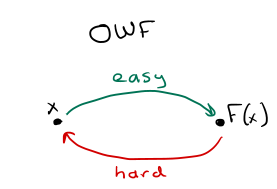
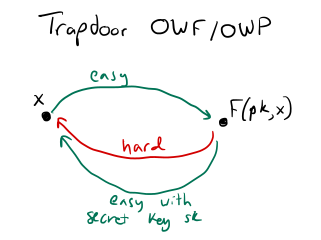
RSA implements a trapdoor one-way function. Informally, a trapdoor one-way function is a function that is easy to compute in the forward direction but that is hard to invert except to someone knowing a secret key. So it is like a one-way function with a “trapdoor” that allows efficient inversion.
RSA actually implements a trapdoor one-way permutation—that is, it maps an input space onto itself with no collisions.
Definition
Formally, a trapdoor one-way permutation over input space \(\calX\) is a triple of efficient algorithms:
If we wanted to be completely formal, the input space would be parameterized by the security parameter \(\lambda\). So we would have a family of input spaces \(\{\calX_\lambda\}_{\lambda \in \N}\)—one for each choice of \(\lambda\). This way the input space can grow with \(\lambda\).
\(\Gen(1^\lambda) \to (\sk, \pk)\). The key-generation algorithm takes as input the security parameter \(\lambda \in \N\), expressed as a unary string, and outputs a secret key and a public key.
\(F(\pk, x) \to y\). The evaluation algorithm \(F\) takes as input the public key \(\pk\) and an input \(x \in \calX\), and outputs a value \(y \in \calX\).
\(I(\sk, y) \to x'\). The inversion algorithm \(I\) takes as input the secret key \(\sk\) and a point \(y \in \calX\), and outputs its inverse \(x \in \calX\).
In the RSA construction, the input space \(\calX\) depends on the public key, but we elide that technical detail here.
Correctness. We want \(F(\pk, \cdot)\) and \(I(\sk, \cdot)\) to be mutually inverse permutations of \(\calX\). Formally, for all \(\lambda \in \N\), \((\sk, \pk) \gets \Gen(1^\lambda)\), and \(x, y \in \calX\): \[ I(\sk, F(\pk, x)) = x \qquad\text{and}\qquad F(\pk, I(\sk, y)) = y. \]
The second identity follows from the first when \(\calX\) is finite: \(I \circ F = \mathrm{id}\) forces \(F\) to be injective, hence a bijection on a finite set, so \(I = F^{-1}\) and the two compose to the identity in either order. We state both because the signature construction below needs the second, and because for a trapdoor one-way function — where \(F\) need not be onto — the second can fail.
Security. Security requires that \(F(\pk, \cdot)\) is hard to invert (in the sense of a one-way function) on a randomly sampled input in the input space \(\calX\), even when the adversary is given the public key \(\pk\). That is, for all efficient adversaries \(\calA\), there exists a negligible function \(\negl(\cdot)\) such that \[ \Pr\left[ \calA(\pk, F(\pk, x)) = x \colon \begin{aligned} (\sk, \pk) &\gets \Gen(1^\lambda)\\ x &\getsr \calX \end{aligned}\right] \leq \negl(\lambda).\]
When we use the RSA cryptosystem, we make the assumption that the RSA function is hard to invert given only the public key:
Definition 6.1 (RSA Assumption) The RSA function \((\Gen, F, I)\) is a trapdoor one-way permutation.
IMPORTANT: Just as a one-way function is only hard to invert on a randomly sampled input, a trapdoor one-way function is only hard to invert on a randomly sampled input. Many of the cryptographic failures of RSA come from assuming that the RSA one-way function is hard to invert on non-random inputs.
Digital signatures from trapdoor one-way permutations
This construction is called “full-domain hash.” (Bellare and Rogaway 1993) The construction makes use of a hash function \(H\) and resulting signature scheme is secure, provided that we model the hash function \(H\) as a “random oracle.”
In other words, to argue security, it is not sufficient to show that \(H\) is, for example, collision resistant. Instead, we can only prove security provided that we pretend that \(H\) is a truly random function—i.e., in the random-oracle model. When we instantiate the hash function \(H\) with some concrete cryptographic hash function, such as SHA256, we hope that the resulting signature scheme is still secure. In practice, this approach works quite well.
One way to think about it is that if a signature scheme is secure in the random-oracle model, then the concrete signature scheme is in some sense secure against attacks that do not exploit the peculiarities of the hash function.
In the construction, we use:
- a trapdoor one-way permutation \((\Gen, F, I)\), and
- a hash function \(H \colon \zo^* \to \calX\), which we model as a random oracle in the security analysis.
Construction. We construct a digital-signature scheme \((\Gen, \Sign, \Ver)\) as follows:
- \(\Gen\) – Just run the key-generation algorithm for the trapdoor one-way permutation.
- \(\Sign(\sk, m) \to \sigma\). Hash the message down to an element \(h\) of the input space \(\calX\) of the trapdoor one-way permutation using the hash function \(H\). Then invert the trapdoor one-way permutation at that point:
- Compute \(h \gets H(m)\).
- Output \(\sigma \gets I(\sk, h)\).
- \(\Ver(\pk, m, \sigma) \to \zo.\)
- Compute \(h' \gets H(m)\).
- Accept if \(F(\pk, \sigma) = h'\).
Notice that the use of a hash function here is critical to security, since (in the random oracle) it means that forging a signature is as hard as inverting \(F\) on a random point in its co-domain. Without the hash function, forging a signature is only as hard as inverting \(F\) on an attacker-chosen point in its co-domain, which could be easy.
Correctness. For all \(\lambda \in \N\), \((\sk, \pk) \gets \Gen(1^\lambda)\) and \(m \in \zo^*\), the signature is \(\sigma = I(\sk, H(m))\), and verification recomputes \(H(m)\) and checks \(F(\pk, \sigma) = F(\pk, I(\sk, H(m))) = H(m)\), which holds by correctness of the trapdoor one-way permutation. Hence, \(\Ver(\pk, m, \Sign(\sk, m)) = 1\).
Security. The intuition here is that if the adversary cannot invert \(F\), it cannot find the preimage of \(H(m)\) under \(F\) for any message on which it has not seen a signature. See Boneh-Shoup Chapter 13.3 for the full security analysis.
6.2 The RSA construction: Forward direction
The algorithms for key-generation and for evaluating the RSA permutation in the forward direction are not too complicated.
In what follows, we present RSA with public exponent \(e=5\). The same construction works with many other choices of \(e\), just by replacing all of the “5”s below with some other small prime: 3, 7, 13, etc. A popular choice of the public exponent \(e\) in practice is \(e=2^{16}+1\). The complexity of computing the RSA function in the forward direction scales with the size of \(e\), so we prefer small choices of \(e\).
\(\Gen(1^\lambda) \to (\sk, \pk)\).
Sample two random \(\lambda\)-bit primes \(p\) and \(q\) such that \(p \equiv q \equiv 4 \pmod 5\).
Set \(N \gets p \cdot q\).
Output \(\sk \gets (p, q)\), and \(\pk = N\).
\(F(\pk = N, x) \to y\).
- The input space for the RSA function is \(\calX = \Z^*_N\)—the set of elements in \(\{0, 1, 2, \dots, N-1\}\) relatively prime to \(N\).
- Output \(y \gets x^5 \bmod N\).
In practice, we usually take the bitlength of primes to be \(\lambda=1024\) or \(\lambda = 2048\).
Standard RSA implementations require the weaker condition that the public exponent \(e\) shares no prime factors with \(p-1\) and \(q-1\). Using the stronger condition \(p \equiv q \equiv 4 \pmod 5\) here simplifies the inversion algorithm.
Remark 6.1. The key-generation algorithm relies on us being able to sample large random primes. One perhaps surprising fact is that there are many many large primes. In particular, if you pick a random \(\lambda\)-bit number, the probability that it is prime is roughly \(1/\lambda\).
For more on this, look up the Prime Number Theorem.
We can sample a random \(\lambda\)-bit prime by just picking random integers in the range \([2^\lambda, 2^{\lambda + 1})\) until we find a prime. We can test for primality in \(\approx \lambda^4\) time using the Miller-Rabin primality test. We also need that there are infinitely many primes congruent to \(4 \bmod 5\), but fortunately there are. Generating RSA keys is expensive—it can take a few seconds even on a modern machine.
Notice that computing the RSA function in the forward direction is relatively fast: it just requires three multiplications modulo a 2048-bit number \(N\). That is, to compute \(x^5 \bmod N\), we compute: \[ (x^2)^2 \cdot x = x^5\mod N.\]
Before describing the RSA inversion algorithm, we discuss why the RSA trapdoor one-way permutation should be hard to invert without the secret key.
Why should the RSA function be hard to invert?
To invert the RSA function, the attacker’s is effectively given a value \(y \getsr \Z^*_N\) and must find a value \(x\) such that \(x^5 = y \bmod N\). Or, put another way, the attacker’s task is essentially the following:
- Given: A polynomial \(p(X) \deq X^5 - y \in \Z_N[X]\), for \(y \getsr \Z^*_N\).
- Find: A value \(x \in \Z^*_N\) such that \(p(x) = 0 \in \Z^*_N\).
So the attacker must find the root of a polynomial modulo a composite integer \(N\).
We work in \(\Z_N^*\) rather than \(\Z_N\) because \(x \mapsto x^5\) is a permutation only on the elements of \(\Z_N^*\). If \(y\) is a non-unit—say \(y = p\)—the equation \(x^5 = y \bmod N\) has no solution at all, so “find a root” would not be a well-posed task. This matters only for a \(\approx 2^{-\lambda+1}\) fraction of \(\Z_N\), and an attacker who stumbled on such a \(y\) could recover \(p\) from \(\gcd(y, N)\) and factor \(N\) outright.
The premise of RSA-style cryptosystems is that we only know of essentially two ways to find roots of polynomials modulo \(N\):
Factor \(N\) into primes and find a root modulo each of the primes. (We will say more on this in a moment.) Since the best known algorithm, the general number field sieve, runs in time \[ \exp\Big( \big(\sqrt[3]{64/9} + o(1)\big) (\ln N)^{1/3} (\ln \ln N)^{2/3} \Big), \] this approach is infeasible at present without knowing the factorization of \(N\).
Find a root over the integers and reduce it modulo \(N\).
For example, it is easy to find a root of polynomials such as: \[\begin{aligned} X + 4 &= 3 &&\mod N,&\\ X + 2Y &= 5 &&\mod N,&\\ X^2 &= 9 &&\mod N\text{, and}&\\ X^2-3x+2 &= (X-2)(X-1) = 3 &&\mod N. \end{aligned}\]
When \(y \getsr \Z_N\), the probability that \(y\) is a perfect 5-th power, and thus that there is an integral root to \(X^5 - y\), is \(\sqrt[5]{N}/N \approx 2^{-8\lambda/5}\), which is negligible in the security parameter \(\lambda\). So solving this equation over the integers is a dead end.
Is inverting the RSA function as hard as factoring the modulus? No one knows—the question has been open since the invention of RSA. We do know that finding roots of certain polynomial equations, such as \(p(X) \deq X^2 - y \bmod N\) for random \(y \getsr \Z_N\) is as hard as factoring the modulus \(N\). But for RSA-type polynomials, the answer is unclear.
For a \(2048\)-bit modulus \(N\) (that is, \(\lambda = 1024\)-bit primes) this is roughly \(2^{117}\) operations. The largest RSA modulus factored to date is \(829\) bits, which took about \(2700\) core-years in 2020. Note that \(\log N = 2\lambda\), so doubling the prime size more than doubles the security level: a \(4096\)-bit modulus costs about \(2^{157}\).
Actually, it suffices to find a root over the rational numbers, but the distinction isn’t important here.
There are many clever attacks for solving polynomial equations modulo composites that work in certain special cases. The most important of these is Coppersmith’s method (Section 6.2.2), which applies whenever the root we are looking for is small.
Coppersmith’s method: finding small roots
There is a third way to find roots of a polynomial modulo \(N\), which works without factoring \(N\) but only when the root we seek is small. (Coppersmith 1997)
Theorem 6.1 (Coppersmith) Let \(f(X) \in \Z_N[X]\) be a monic polynomial of degree \(d\). Then there is a polynomial-time algorithm that finds all integers \(x_0\) with \(f(x_0) \equiv 0 \bmod N\) and \[ |x_0| < N^{1/d}. \]
The method builds a lattice whose vectors correspond to polynomials that vanish at \(x_0\) modulo a high power \(N^k\), and then runs the LLL lattice-reduction algorithm (Lenstra et al. 1982) to find a combination \(g\) whose coefficients are so small that \(|g(x_0)| < N^k\). But \(g(x_0)\) is also a multiple of \(N^k\), and the only multiple of \(N^k\) smaller in absolute value than \(N^k\) is zero. So \(g(x_0) = 0\) holds over the integers, and we can recover \(x_0\) by ordinary root-finding.
In one sentence: lattice reduction converts a modular equation into an integer equation, and integer equations we know how to solve. The bound \(N^{1/d}\) is essentially the point at which \(f(x_0)\) stops wrapping around the modulus.
The theorem also applies when \(x_0\) is close to a known value rather than close to zero: substituting \(X = \tilde{x} + X'\) for a known guess \(\tilde x\) turns “\(x_0\) is within \(N^{1/d}\) of \(\tilde x\)” into “the root of the shifted polynomial is small.” This is what makes the method dangerous in practice, and it has several consequences for RSA.
Partial knowledge of a prime factor is fatal. Given roughly the top half of the bits of \(p\)—that is, \(p = \tilde p + x_0\) with \(\tilde p\) known and \(|x_0| < N^{1/4}\)—one can factor \(N\) in polynomial time. RSA keys tolerate no partial leakage of their primes whatsoever.
Structured primes are fatal. The ROCA vulnerability (Nemec et al. 2017) concerned a widely deployed library that generated primes of the special form \(p = k \cdot M + (65537^a \bmod M)\) for a fixed constant \(M\). That structure leaves few enough unknowns that Coppersmith’s method factors the modulus: 1024-bit keys fell in a few hundred CPU-hours. Affected keys were identifiable from the public modulus alone, and the flaw forced a mass revocation of national identity certificates.
A small private exponent is fatal. If \(d < N^{0.292}\), the modulus can be factored (Boneh and Durfee 2000), improving an earlier bound of \(N^{0.25}\) due to Wiener. This is why we choose a small public exponent \(e\) to speed up the forward direction, and never a small private exponent \(d\).
None of this breaks the scheme as we have presented it. Full-domain hash applies the RSA function to \(H(m)\), which is a uniform element of \(\Z^*_N\) with no small or structured part, so Theorem 6.1 has no small root to find. But it does sharpen the warning made earlier in this chapter: the RSA function is assumed hard to invert only on random inputs, and Coppersmith’s method is the concrete reason that inputs which are small, structured, or partially known are a different matter entirely.
6.3 The RSA construction: Inverse direction
To understand how the inversion algorithm works, we will need some number-theoretic tools.
Tools from number theory
For a natural number \(N\), let \(\phi(N)\) denote the number of integers in \(\Z_N = \{0, 1, 2, \dots, N-1\}\) that are relatively prime to \(N\). When \(p\) is prime \(\phi(p) = p-1\). The function \(\phi(\cdot)\) is called Euler’s totient function.
Two natural numbers are relatively prime if they share no prime factors.
When \(N=pq\) is the product of two distinct primes, \(\phi(N) = (p-1)(q-1)\). That is so because all numbers in \(\Z_N\) are relatively prime to \(N\) except \(0\) and the multiples of \(p\) and \(q\): \[ p, 2p, 3p, \dots, (q-1)p,\ \ \ q, 2q, 3q, \dots, (p-1)q.\] So there are \(N - 1 - (q-1) - (p-1) = (p-1)(q-1)\) numbers in \(\Z_N\) relatively prime to \(N\).
Theorem 6.2 (Euler’s Theorem) Let \(N\) be a natural number. Then for all \(a \in \Z^*_N\), \[ a^{\phi(N)} = 1 \mod N.\]
Proof. Consider the sets \(\Z^*_N\) and \(\{ax \bmod N \mid x \in \Z^*_N\}\). These sets are equal, so the product of the elements in the two sets is equal. Let \(X \gets \prod_{x \in \Z^*_N} x \bmod N\). Then \[ X = a^{\phi(N)}X \bmod N \quad \Rightarrow\quad 1 = a^{\phi(N)} \bmod N.\]
Lemma 6.1 Let \(p\) and \(q\) be distinct primes congruent to \(4\) modulo \(5\). Define the integer \(d = \frac{\phi(N) - 4}{5} + 1\). Then \(5d \equiv 1 \bmod \phi(N)\).
Proof. Since \(p \equiv q \equiv 4 \pmod 5\), we have \(p - 1 \equiv q - 1 \equiv 3 \pmod 5\), and so \[ \phi(N) = (p-1)(q-1) \equiv 3 \cdot 3 = 9 \equiv 4 \pmod 5. \] Hence \(\phi(N) - 4 \equiv 0 \pmod 5\), so \(\frac{\phi(N)-4}{5}\) is an integer and \(d\) is well defined. Then \[ 5d = \big(\phi(N) - 4\big) + 5 = \phi(N) + 1 \equiv 1 \pmod{\phi(N)}. \]
Inverting the RSA function
With the number theory out of the way, we can now describe how to invert the RSA function. All we have to do is to show how to compute a fifth root of \(y \bmod N\).
- \(I(\sk, y) \to x\).
- The secret key \(\sk\) consists of the prime factors \(p,q\) of \(N\). Recall that \(\phi(N) = (p-1)(q-1)\).
- Compute the integer \(d \gets \frac{\phi(N) - 4}{5} + 1\), as in
- Return \(y^d \bmod N\).
We sometimes call \(d\) the private exponent in RSA.
It is not obvious why the inversion algorithm is correct. Say that \(y = x^5 \bmod N\). Then: \[\begin{aligned} y^d &= (x^5)^d &&\bmod N\\ &= x^{5d} &&\bmod N\\ &= x^{k \cdot \phi(N) + 1} &&\bmod N, \end{aligned}\] for some \(k \in \Z\), by 1, and \[\begin{aligned} &= x \cdot (x^{\phi(N)})^k &&\bmod N\\ &= x &&\bmod N, \end{aligned}\] by Theorem 6.2. We could write \(5d = k \phi(N) + 1\) because from 1, we know that \(5d \equiv 1 \bmod \phi(N)\).
Using other public exponents. For our RSA-inversion algorithm to work, we need only to compute the multiplicative inverse \(e\) modulo \(\phi(N)\). That is, we need to compute an integers \(d\) such that \(ed \equiv 1 \bmod \phi(N)\). Such an inverse always exists when \(e\) and \(\phi(N)=(p-1)(q-1)\) are relatively prime. RSA implementations typically use the extended Euclidean algorithm to compute the multiplicative inverse of \(e\) modulo \(\phi(N)\). That algorithm is more general, but the one we used in 1 is simpler and is self-contained.
Inverting RSA is easy on a negligible fraction of points. If the preimage \(x\) of a point \(y\) under the RSA function is very small, inverting the function is easy: when \(x < N^{1/5}\), the value \(x^5\) never wraps around the modulus, so \(y = x^5\) holds over the integers and we can recover \(x\) by taking an ordinary fifth root. More generally, Theorem 6.1 recovers \(x\) whenever it lies within \(N^{1/5}\) of a value we can guess. For a uniformly random \(y \getsr \Z^*_N\) such an \(x\) occurs only with negligible probability \(\approx 2^{-4\lambda/5}\), which is why the RSA assumption is stated for random inputs.
Is inverting RSA as hard as factoring the modulus \(N\)? The inversion algorithm we showed here requires knowing the prime factors of the modulus \(N\). Inverting RSA is thus no harder than factoring \(N\).
Is inverting RSA as hard as factoring \(N\)? In particular, if we have an efficient algorithm \(\calA\) that inverts RSA, can we use \(\calA\) to factor the modulus \(N\)? No one knows!
Most cryptographers, I would guess, believe that inverting the RSA function is as hard as factoring. But for all we know, it could be that computing fifth roots modulo \(N\) is easier than factoring the modulus.
The RSA inversion assumption corresponds to assuming that inverting RSA is hard.