4 Message Authentication Codes
\[ \newcommand{\F}{\mathbb{F}} \newcommand{\G}{\mathbb{G}} \newcommand{\N}{\mathbb{N}} \newcommand{\R}{\mathbb{R}} \newcommand{\Z}{\mathbb{Z}} \newcommand{\Zq}{\Z_q} \newcommand{\zo}{\{0,1\}} \newcommand{\bin}{\zo} \newcommand{\zon}{\{0,1\}^n} \newcommand{\A}{\mathcal{A}} \newcommand{\B}{\mathcal{B}} \newcommand{\calA}{\mathcal{A}} \newcommand{\calB}{\mathcal{B}} \newcommand{\calC}{\mathcal{C}} \newcommand{\calD}{\mathcal{D}} \newcommand{\calK}{\mathcal{K}} \newcommand{\calM}{\mathcal{M}} \newcommand{\calT}{\mathcal{T}} \newcommand{\calX}{\mathcal{X}} \newcommand{\calY}{\mathcal{Y}} \newcommand{\xor}{\oplus} \newcommand{\cross}{\times} \newcommand{\deq}{\mathrel{\mathop:}=} \newcommand{\abs}[1]{\left| #1 \right|} \newcommand{\set}[1]{\left\{ #1 \right\}} \renewcommand{\vec}[1]{\mathbf{#1}} \newcommand{\poly}{\operatorname{poly}} \newcommand{\negl}{\operatorname{negl}} \newcommand{\classP}{\mathsf{P}} \newcommand{\classNP}{\mathsf{NP}} \newcommand{\INDCPA}{\text{IND-CPA}} \newcommand{\Enc}{\mathsf{Enc}} \newcommand{\Dec}{\mathsf{Dec}} \newcommand{\Gen}{\mathsf{Gen}} \newcommand{\Derive}{\mathsf{Derive}} \newcommand{\Sign}{\mathsf{Sign}} \newcommand{\Ver}{\mathsf{Ver}} \newcommand{\MAC}{\mathsf{MAC}} \newcommand{\MACSign}{\mathsf{MAC.Sign}} \newcommand{\MACVerify}{\mathsf{MAC.Verify}} \newcommand{\Funs}{\mathsf{Funs}} \newcommand{\ToString}{\mathsf{ToString}} \newcommand{\sk}{\mathsf{sk}} \newcommand{\pk}{\mathsf{pk}} \newcommand{\vk}{\mathsf{vk}} \newcommand{\sig}{\sigma} \newcommand{\rgets}{\mathrel{\overset{\scriptscriptstyle\mathrm{R}}{\leftarrow}}} \newcommand{\getsr}{\rgets} \newcommand{\bits}{\{0,1\}} \newcommand{\Tag}{\operatorname{Tag}} \newcommand{\Vrfy}{\operatorname{Verify}} \newcommand{\EncAM}{\operatorname{Enc}^{\mathrm{E\&M}}} \newcommand{\DecAM}{\operatorname{Dec}^{\mathrm{E\&M}}} \newcommand{\EncME}{\operatorname{Enc}^{\mathrm{MtE}}} \newcommand{\DecME}{\operatorname{Dec}^{\mathrm{MtE}}} \newcommand{\concat}{\,\|\,} \]
So far, we have talked about authenticating people and authenticating files. In this section, we will discuss authenticating communication. If we have two parties that are communicating over the network, we want some way to guarantee to each party that the message they received really came from the other party and was not tampered with along the way.
At a first glance, this seems impossible. If there is some eavesdropper Eve in between the two parties, they can just replace the message with one of their own choosing and the other party will have no idea. To make this possible, we need to relax the scenario a bit and add an assumption—that the two parties share some secret key \(k\).
With this shared key \(k\) between the two parties, our goal will be to add some “tag” onto the message that validates its authenticity. Necessarily, this tag will be a function of this shared key \(k\). If this were not the case, the eavesdropper would be able to compute a valid tag herself—the secret \(k\) is the only information in this scenario that Eve does not know.
4.1 Defining message authentication codes
Syntax. A message authentication code (MAC) over key space \(\mathcal{K}\), message space \(\mathcal{M}\) , and tag space \(\calT\) is an efficient algorithm \(\MAC \colon \calK \times \calM \to \calT\). In order for a MAC to be useful, it must be secure, in the following sense. We first give the definition and then explain why it is a useful one:
Definition 4.1 (MAC Security: Existentially unforgeability against adaptive chosen message attacks) A message authentication code \(\MAC\) over key space \(\calK\) and message space \(\mathcal{M}\) is secure (existentially unforgeable against adaptive chosen message attacks) if any poly-time adversary \(\mathcal{A}\) wins the following game with at most negligible probability:
In practice, “a poly-time adversary” means “any real-life adversary”. But we need to place some mathematical bound on real-life to make the proofs work out.
- The challenger samples a MAC key \(k \getsr \calK\).
- For \(i = 1, 2, \dots\) (polynomially many times)
- The adversary sends any message \(m_i \in \calM\) to the challenger
- The challenger responds with \(\mathsf{MAC}(k, m_i)\).
- The adversary sends the challenger a message-tag pair \((m^*, t^*)\).
- The adversary wins the game if \(\mathsf{MAC}(k, m^*) = t^*\) and \(m^* \notin \set{m_1, m_2, \ldots, m_n}\).
A subtlety of this definition is that, even if the MAC scheme is secure under this definition, it is possible for an adversary, given a valid message-tag pair \((m,t)\) to produce a second valid message-tag pair \((m,t')\) on the same message without knowing the secret key.
Intuition for the security definition
To formulate our security notion, we need to define the adversary’s goal and the adversary’s power.
The adversary’s goal in this definition is to compute a valid MAC of any message \(m\in \mathcal{M}\) of its choice. It’s not entirely obvious why we care about the adversary producing a valid MAC on any message: “If the adversary MACs a message that is gibberish, they are unlikely to be able to do any harm with it,” you might think. But there will certainly be applications that authenticate messages that violate whatever definition of “non-gibberish” we define. So allowing the adversary to forge a MAC tag on any message makes the definition as broadly applicable as possible.
As far as the adversary’s power goes: we, as usual in cryptography, restrict the adversary to be efficient (i.e., to run in polynomial time). But in the MAC security game we also allow the adversary to obtain MAC tags on messages of its choice. This captures the reality that in many systems, an adversary can trick an honest system into MACing adversarial messages. For example, if an email-backup system MACs every email that a user receives, an adversary may be able to obtain MAC tags on messages of its choice by sending emails to the backup system.
This has some interesting implications—importantly, the adversary can store these messages along with their MAC and replay them later.
MACs require pseudorandomness
The fact that it is even possible to construct a MAC seems a bit surprising—in effect, for a MAC to satisfy the definition, the tag has to effectively be random. But the only “randomness” that we have is the key \(k\)—to generate tags for arbitrarily many messages, we need much more randomness than one key’s worth. This seems impossible. How can we generate a large number of random-looking tags from only a single short random key?
We get ourselves out of this conundrum by observing that the adversary must be an efficient algorithm. So while we cannot generate a large number of truly random bits from a short key, we can—under appropriate and reasonable cryptographic assumptions—generate a large number of bits that look truly random from the perspective of any efficient algorithm. We call these bits pseudorandom.
This surprising and powerful idea leads us to our next cryptographic primitive\(\ldots\)
4.2 Pseudorandom Functions
A pseudorandom function is defined over a keyspace \(\calK\), and input space \(\calX\) and output space \(\calY\). To be useful a pseudorandom function must satisfy the following security definition:
Definition 4.2 (Pseudorandom Function, PRF) A function \(F: \mathcal{K} \cross \calX \rightarrow \calY\) is a pseudorandom function if all efficient algorithms \(\mathcal{A}\) win the following game with probability \(\tfrac{1}{2} + \text{``negligible''}\):
The challenger samples a random bit \(b \gets \zo\) and a key \(k \getsr \calK\).
If \(b = 0\), the challenger sets \(f(\cdot) \deq F(k, \cdot)\).
If \(b = 1\), the challenger sets \(f(\cdot) \getsr \Funs[\calX, \calY]\).
Then for \(i = 1, 2, \dots\) (polynomially many times):
- The adversary sends the challenger a values \(x_i \in \calX\).
- The challenger responds with \(y_i \gets f(x_i) \in \calY\).
The adversary outputs a guess \(\hat{b}\) at the bit \(b\).
The adversary wins if \(b = \hat{b}\).
Here, \(\Funs\) is the set of all functions from \(\calX\) to \(\calY\).
First, the challenger will sample a random \(b \leftarrow \bin\) and a key \(k \leftarrow \mathcal{K}\).
The adversary can trivially win this game with probability \(\tfrac{1}{2}\) by just guessing the bit \(b\) at random. This definition asserts that no efficient adversary can do much better than that.
If we have such a pseudorandom function \(F\), we could easily construct a MAC—we can just use the message as the input to the pseudorandom function along with the key: \(\MAC(k, m) \deq F(k, m)\).
Constructing pseudorandom functions from one-wayness
It is not at all obvious that pseudorandom functions should exist at all! They seem like a very magical primitive indeed.
One surprising fact is that if there exists any function that is “hard to invert,” in a sense we will define, then pseudorandom functions exist. For example, if you believe that factoring large numbers is difficult (as many people do), then pseudorandom functions exist.
In particular the following definition captures the notion of a function that is hard to invert:
Definition 4.3 (One-Way Function) A function \(f \colon \calX \to \calY\) is a one-way function if for all efficient adversaries \(\calA\), \[ \Pr[f(\calA(f(x))) = f(x) \colon x \getsr \calX ] \leq \text{``negligible''}.\]
Having defined one-way functions, we now have the following surprising and non-obvious result:
Notice that if \(\classP = \classNP\), one-way functions do not exist, and therefore psuedorandom functions do not exist.
Theorem 4.1 Psueodorandom functions exist if and only if one-way functions exist. (Hastad et al. 1999)
In practice, we assume that:
- the function \(f(x) \deq \text{SHA256}(x)\) is a one-way function where the domain is the set of 256-bit strings,
- the function \(f(x) \deq \text{AES}(x, 0^{128})\) is a one-way function, where the domain is the set of 128-bit strings, and
- the function \(f(x) \deq 2^x \bmod p\) is a one-way function on domain \(\{1, \dots, p\}\), for a sufficiently large prime \(p\).
Pseudorandom functions in practice
In practice, we use the Advanced Encryption Standard (AES) as a pseudorandom function. The AES function on key length \(\kappa \in \{128, 192, 256\}\) has the type signature \(\mathsf{AES}: \bin^\kappa \times \bin^{128} \rightarrow \bin^{128}\). That is, it takes a 128-bit input and generates a 128-bit output.
We don’t have any mathematical proof that AES is a pseudorandom function. However, it has undergone a tremendous amount of cryptanalysis and the best attacks on AES are only marginally better than the obvious brute-force attacks.
4.3 From pseudorandom functions to MACs
MACs for short messages. Using AES as a pseudorandom function on a 128-bit domain, we can build a MAC for 128-bit messages as described above : \(\MAC(k, m) \deq \mathsf{AES}_k(m)\). However, since AES takes only 128 bits as input, using AES directly, we can only authenticate 128-bit messages.
Insecure ways to construct a MAC for long messages. A bad way to construct a MAC for long messages from a pseudorandom function \(F\) for 128-bit messages is just to chop our message \(m\) up into 128-bit blocks \(m = (m_1, m_2, \dots)\) and MAC each block separately. Our tag, then, would look something like \(\left(F(k,m_1), F(k,m_1)\right)\). However, there is a problem! Given the tag \(t = (t_1, t_2)\) for a message \(m=(m_1, m_2)\), we can easily generate a valid tag \(t' = (t_2, t_1)\) for a different message \(m'=(m_2, m_1)\).
MACs for long messages: The easy way. If we have a pseudorandom function \(F\) with an input space of 256-bits, we can construct a MAC on arbitrary-length messages using the “hash-and-sign” paradigm. In particular, we use a collision-resistant hash function \(H\colon \zo^* \to \zo^{256}\) (Definition 3.1) and we define the MAC on message space \(\zo^*\) as: \[ \MAC(k,m) \deq F(k, H(m)).\]
Notice that we cannot use AES as the pseudorandom function \(F\) in this construction, since AES only takes a 128-bit input. In this case, we would need a collision-resistant hash function \(H \colon \zo^* \to \zo^{128}\), but it is always possible to find collisions in hash functions with 128-bit output in time \(2^{64}\). So such a MAC can never be secure against attackers running in time \(2^{64}\).
In practice, we typically do not construct MACs in this way because collision-resistant hash functions are typically more expensive to compute (per bit of input) than pseudorandom functions, such as AES.
MACs for long messages: Cipher-Block Chaining MAC
Applying the PRF to the last block using an independent random key is important. If we use the same key \(k\), an adversary can mount a length-extension attack. Writing \(E(x) = F(k,x)\), an \(n\)-block message costs \(n+1\) applications of \(E\). The adversary queries the one-block message \(m_1\), receiving \(t = E(E(m_1))\), and then queries the one-block message whose contents are the bit string \(t\), receiving \(t' = E(E(t))\). But \(\mathsf{MAC}(k, m_1 \| 0 \| 0) = E(E(E(E(m_1)))) = E(E(t)) = t'\), so \(t'\) is a valid tag on a message the adversary never queried. Two zero blocks are needed because the second query contributes two applications of \(E\): one for its message block and one for its final step. A zero block is free to append since \(0 \oplus t_{i-1} = t_{i-1}\), so it passes the chaining value through and adds one more \(E\).
A common and secure way to construct a MAC for long messages from a MAC for short messages is to chain the output of each of these calls to the pseudorandom function. Given our chopped message \((m_1, m_2, \ldots, m_n)\), we will generate \(t_1 = F(k,m_1)\) as before. When generating \(t_2\), we will first XOR \(t_1\) into the input: \(t_2 = F(k, m_2 \oplus t_1)\). This continues until the end of the message, at which point have a tag \(t_n\). Finally, we apply the PRF with a different key \(k'\) to the value \(t_n\) and output this tag \(t \gets F(k', t_n)\). This construction is called CBC-MAC or CMAC.
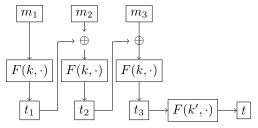
CBC-MAC is going out of favor for two reasons:
- It is impossible to parallelize the MAC computation: the chaining procedure is inherently sequential so you cannot speed it up, even if you have a computer with many CPU cores.
- Computing the MAC requires one PRF invocation per block of the message. There are even faster MACs that require only one PRF invocation per message total, plus a number of fast “non-cryptographic” operations per message block. These MACs can be faster than CBC-MAC on some processors. The GMAC construction we will see next is one example.
A parallelizable MAC: Carter-Wegman MAC
We now describe a different way to authenticate long messages. This MAC scheme is parallelizable and also requires only one single PRF invocation per message authenticated (independent of the message length). The construction is named the Carter-Wegman MAC, after its inventors.(Wegman and Carter 1981) Modern encryption schemes, including AES-GCM (Section 9.5) use a Carter-Wegman-style MAC as a key ingredient.
For this construction, we will use the notation \(\Z_p\) to indicate the set of integers modulo \(p\) with addition and multiplication modulo \(p\). So \(x + y \in \Z_p\) means that we add \(x\) and \(y\) as integers and reduce the result modulo \(p\). Typically, we will think of \(p\) as a prime—of 64 bits, for example. The construction uses a fixed a prime number \(p\) as a parameter, where \(p \approx 2^n\) for security parameter \(n\).
So in practice, we take \(p \approx 2^{128}\) for 128-bit security.
Universal hash function.
Before we look at the construction of the Carter-Wegman MAC, we first define an important building block: the notion of a universal hash function, or UHF for short. A universal hash function is keyed, and provides collision-resistance when the adversary does not know the key. Specifically, we say that \(H\) is a universal hash function if, when an adversary chooses two messages \(m\) and \(m'\) where \(m\neq m'\),
\[ Pr[H(k, m) = H(k, m')] \leq \text{negl.} \]
Intuitively, a universal hash function is a weaker primitive than a collision-resistant hash function: the adversary does not know the precise hash function that will be applied to their messages, because the adversary does not know what key will be used.
One simple and practical construction of a universal hash function is based on polynomials. Given a long message \(m\), break it up into fixed-size chunks \(m_1, m_2, \ldots, m_{l}\). Then, the hash of that message is defined as:
In practice, these fixed-size chunks are going to be 128 or 256 bits long.
\[ H(k, m_1 || m_2 || \ldots || m_{l}) = (m_1 + m_2 k + m_3 k^2 + \ldots + m_{l} k^{l-1} + k^{l}) \mod p \]
The final monic term \(k^l\) is essential, even though it involves no message block. Without it, a message and the same message with trailing zero chunks appended hash to the same value for every key: the added chunks contribute nothing to the sum. The term \(k^l\) makes the map from messages to polynomials injective, since the degree records the number of chunks and the remaining coefficients record their contents.
We can give some intuition for why \(H\) is a universal hash function (i.e., collision-resistant for a randomly chosen key). In order for a pair of messages \(m\) and \(m'\) to collide, it must mean that \(H(k, m) = H(k, m')\), which in turn means that \(H(k, m) - H(k, m') = 0\). Expanding the definition of \(H\) as a polynomial, this means that
\[ (m_1 - m'_1) + (m_2 - m'_2) k + \ldots + (m_{l} - m'_{l}) k^{l-1} + (k^{l} - k^{l'}) = 0 \]
which is another way of saying that \(k\) is a root of that polynomial. That polynomial is not identically zero. If the two messages have the same number of chunks \(l = l'\), the two monic terms cancel and some coefficient \(m_i - m'_i\) is non-zero because \(m \neq m'\). If instead \(l < l'\), the term \(-k^{l'}\) survives and the polynomial has degree exactly \(l'\). Either way we have a non-zero polynomial of degree at most \(\max(l, l')\), so it has at most that many roots, but there are \(p \approx 2^n\) possible choices for \(k\). The probability that our randomly-chosen \(k\) happens to be one of those roots is therefore at most \(\frac{\max(l,l')}{p}\), which is negligible.
MAC construction.
The MAC uses a pseudorandom function \(F \colon \calK \times \Z_p \to \Z_p\). The keyspace for the MAC is \(\calK\), so the MAC key consists of a key for the pseudorandom function. The message space for the MAC is \(\calM = \Z_p^{\leq L}\), the set of vectors of integers of \(\Z_p\) elements of length at most \(L\) where \(L \ll p\). Here, assume that the message vector has length at least \(1\).
Here, the input space of the pseudorandom function \(F\) is the set of integers in \(\{0, \dots, p-1\}\). Given a pseudorandom function on bitstrings, it is indeed possible to construct one that operates on numbers in \(\Z_p\) like this by interpreting each number as a bitstring.
One other difference is that this MAC construction is randomized. So there are now two algorithms:
- \(\MACSign(k, m) \to t\), which takes as input a key \(k\) and message \(m\) and outputs a MAC tag \(t\), and
- \(\MACVerify(k, m, t) \to \zo\), which takes as input a key \(k\), message \(m\), tag \(t\), and outputs an accept/reject bit.
The security definition here is essentially the same as for deterministic MACs, except that we use different algorithms to generate and verify the MAC tags.
The Carter-Wegman MAC construction is then:
\(\MACSign(k, m \in \Z^{\leq L}_p) \to t\).
Compute \(v \gets F(k, 0) \in \Z_p\).
Parse the message into chunks as \((m_1, \dots, m_{\ell}) \gets m \in \Z_p^\ell\).
Compute \(M(v) \gets m_1 v + m_2 v^2 + m_3 v^3 + \cdots + m_{\ell} v^{\ell} + v^{\ell+1} \in \Z_p\).
Sample a nonce \(r \getsr \Z_p\).
Output \(t \gets \big(r, F(k, r) + M(v)\big) \in \Z^2_p\) as the MAC tag.
Essentially we are viewing the blocks of the message \(m\) as coefficients of a degree-\((\ell+1)\) polynomial \(M(\cdot)\). We then evaluate this polynomial at the secret point \(v\) determined by the MAC key. The trailing monic term \(v^{\ell+1}\) carries no message block; its job is to record the message length in the degree.
\(\MACVerify(k, m, t) \to \zo\).
- Compute \(v \gets F(k, 0) \in \Z_p\).
- Parse the message into chunks as \((m_1, \dots, m_{\ell}) \gets m \in \Z_p^\ell\).
- Compute \(M(v) \gets m_1 v + m_2 v^2 + m_3 v^3 + \cdots + m_{\ell} v^{\ell} + v^{\ell+1} \in \Z_p\).
- Parse the tag \((r, z) \gets t \in \Z^2_p\).
- Output “1” if and only if \(z - F(k, r) = M(v)\).
Why the trailing monomial? Suppose we had defined \(M(v) = m_1 v + \dots + m_{\ell} v^{\ell}\), without the final \(v^{\ell+1}\) term. Then appending a zero block to a message would leave the polynomial unchanged, and the scheme would be forgeable after a single query. An adversary asks for a tag on the one-block message \(m = (m_1)\) and receives \(t = (r, z)\) with \(z = F(k,r) + m_1 v\). The message \(m^* = (m_1, 0) \neq m\) has \[ M^*(v) = m_1 v + 0 \cdot v^2 = m_1 v = M(v), \] so \(\MACVerify(k, m^*, t)\) accepts the very same tag, with probability \(1\). More generally \(m\) and \(m \| 0^j\) would collide for every \(j\). The trailing monic term rules this out by making the map from messages to polynomials injective: the degree of \(M\) determines \(\ell\), and the remaining coefficients determine \(m_1, \dots, m_{\ell}\).
Security intuition. The security argument here goes as follows:
For a detailed treatment of Carter-Wegman security see Boneh and Shoup’s textbook, A Graduate Course in Applied Cryptography, Section 7.4.
First, we appeal to the PRF security property to argue that we can replace the values \(F(k_F, r)\) used to generate the tags with truly random values.
Next, we show that as long as the \(\MACSign\) algorithm never samples the same nonce \(r\) twice, the masking values \(F(k,r)\) are independent random values that completely hide the values \(M(v)\). So, the adversary learns no information on the secret point \(v\) by making MAC queries.
Now, say that the adversary finds a forged message-tag pair \((m^*, t^*)\). There are two cases:
Either the forgery uses a fresh random nonce \(r^*\) that did not appear as the response to any of the adversary’s MAC queries. In this case, the forgery is only valid with probability \(1/p\).
Alternatively, the forger could use a random nonce \(r^*\) that is equal to the nonce \(r\) returned from one of the adversary’s MAC queries. In this case, we have the following relations, where \(M\) is the polynomial of the message \(m\) that the adversary queried of the challenger: \[\begin{aligned} F(k, r) &= z - M(v)\\ F(k, r) &= z^* - M^*(v)\\ 0 &= \big(M(v) - M^*(v)\big) + (z^* - z). \end{aligned}\] Since \(m \neq m^*\) and the message encoding is injective, \(M(\cdot)\) and \(M^*(\cdot)\) are distinct polynomials, so \(\big(M(\cdot) - M^*(\cdot)\big) + (z^* - z)\) is not identically zero.
It is a non-zero polynomial of degree at most \(L+1\), so it has at most \(L+1\) roots in \(\Z_p\). Since the adversary’s view is independent of the evaluation point \(v \in \Z_p\), the probability that the adversary’s forgery is valid is at most \((L+1)/p\).
In either case, the adversary’s probability of forging is \(O(L)/p = \poly(\lambda) \cdot \negl(\lambda) = \negl(\lambda)\) on security parameter \(\lambda\).
The added constant \(z^* - z\) cannot cancel \(M(\cdot) - M^*(\cdot)\), because neither \(M\) nor \(M^*\) has a constant term, so their difference is never a non-zero constant.
Note that nonce reuse is catastrophic. Say two distinct messages \(m \neq m'\) that produce \((r, z)\) and \((r, z')\), where \(z = F(k,r) + M(v)\) and \(z' = F(k,r) + M'(v)\). The adversary is able to discover the secret value \(v\), and then forge any message.